
Blogs and insights
Why Northern Michigan Homeowners Love Our Same-Day Awning Installation Services
📅 Published on
June 18, 2026

Same-day awning installation in Northern Michigan means your project starts and finishes in a single visit, typically in three to six hours, without staging materials across multiple days or coordinating repeat site visits. For homeowners in Traverse City and the surrounding area, that speed matters because the usable outdoor season is short. Waiting two to three weeks for a multi-day installation schedule can cost you a meaningful portion of the summer. This post explains how same-day awning installation works, which awning types qualify, what to expect on install day, and why the process is faster than most homeowners expect when they first call for a quote.
What Same-Day Awning Installation Actually Means
The term gets used loosely, so it is worth defining clearly. Same-day installation means that the installation crew arrives with all materials, hardware, and tools already prepped for your specific job, completes the mounting and any required surface preparation, and leaves you with a fully functional awning on the same calendar day. It does not mean an emergency rush service or a shortcut on workmanship. It is the standard installation model for retractable and fixed awnings on prepared residential structures.
Why Awnings Install Faster Than Other Outdoor Structures
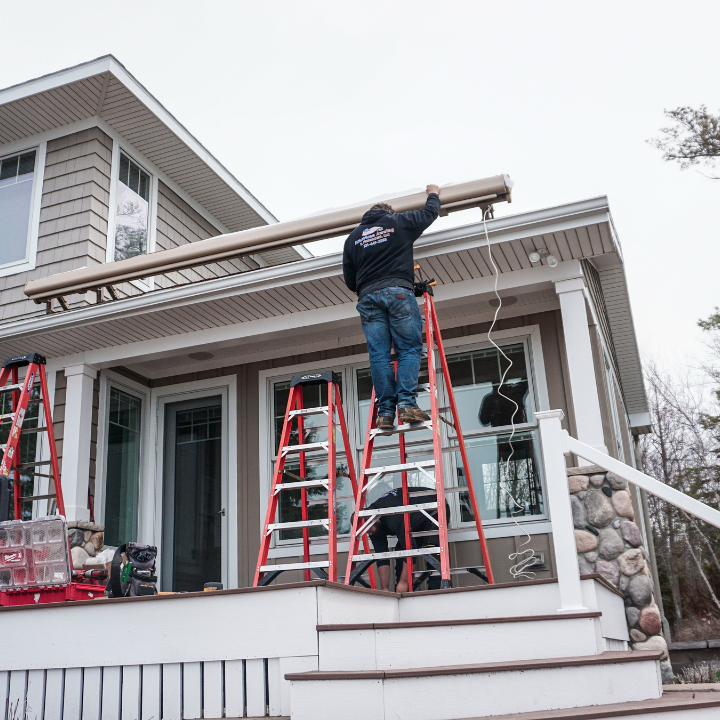
Unlike a sunroom addition or a new deck build, a residential awning does not require a foundation, concrete work, framing inspections, or multi-day sequencing. The mounting hardware attaches directly to your home's fascia, soffit, or exterior wall using lag bolts that anchor into structural framing members. The awning fabric and frame arrive pre-assembled or in two to three major components that connect on-site. Once the mounting bracket positions are measured, leveled, and drilled, the frame goes up, the fabric is tensioned, and any motorization wiring is run. From start to cleanup, most jobs finish in an afternoon.
The Pre-Installation Prep That Makes It Possible
Same-day completion depends on the work done before the crew shows up. During your consultation, measurements are taken and the specific awning configuration, fabric, color, and motor options are confirmed. That information goes to the fabricator, and materials are ordered and staged before your install date is scheduled. When the crew arrives, they are not figuring out the job on the fly. Every component is accounted for, every mounting location is already mapped from the site assessment, and the sequence is established before the first drill bit touches your wall.
Awning Types That Qualify for Same-Day Installation
Not every awning style installs in a single day, but the most popular residential options do. Here is what typically qualifies and what takes longer.
Retractable Awnings
Retractable awnings are the most common same-day installation. The frame, fabric cassette, and motor (if applicable) arrive as a single integrated unit. Mounting involves setting two to four wall brackets, hanging the cassette, confirming the pitch angle, connecting power for motorized models, and testing operation. A standard 12-foot to 20-foot retractable awning with a single-motor drive installs in two to four hours. Wider spans or dual-motor configurations take slightly longer but rarely extend the job beyond one day.
Fixed Frame Awnings
Fixed frame awnings, including shed-style and dome awnings over doors and windows, also install in a single day. The frame components are typically pre-cut to your opening dimensions and arrive ready to assemble. Most residential fixed awnings install in one to three hours. Commercial-scale fixed awnings over large storefronts or multiple bays may require a second day for welding or custom powder-coat touches, but standard residential sizes do not.
Freestanding and Lateral-Arm Awnings
Freestanding awning structures that do not attach to the home wall require setting posts, which may involve concrete footings that need cure time. Lateral-arm awnings that extend from a pergola or separate post system fall into the same category. If your installation requires new ground-set posts, same-day completion is generally not possible. In those cases, the post-setting work is done on day one and the awning frame and fabric installation follows on day two once the concrete has set. For true wall-mount configurations, same-day is the standard. See the range of outdoor shade solutions we offer if you are exploring options beyond a wall-mounted awning.
Same-Day vs. Multi-Day Installation: Side-by-Side Comparison
The table below compares the two installation models across the factors that matter most to homeowners planning a project this season.
Why Same-Day Installation Matters More in Northern Michigan
Northern Michigan's outdoor season runs roughly from late May through early October, a window of about 18 to 20 weekends. That is a narrow margin. A two-week installation timeline that ties up your patio during the best weeks of July costs you real time that you cannot recover. Same-day installation eliminates that cost. You book a single date, the crew comes out, and the awning is functioning before sunset. The next morning, the space is yours.
The Weather Window Problem
Northern Michigan weather is unpredictable at the shoulders of the season. A multi-day installation that requires good weather on both day one and day two faces twice the risk of a rain delay. Same-day jobs only need one clear window, which means scheduling is more predictable and follow-up rescheduling is far less common. From a purely practical standpoint, fewer moving parts means fewer things that can go wrong with the calendar.
Seasonal Demand and Booking Lead Times
Installation demand in Traverse City and the surrounding area peaks in May and June as homeowners prepare for summer. Contractors with multi-day installation requirements book further out because each project ties up the crew for longer. Same-day installation allows more projects to be completed per week, which means shorter lead times and more flexibility for homeowners who decide in late June that they want shade on their patio by July 4th. If you are planning for this season, schedule your free consultation early to lock in your preferred install date before the summer backlog builds.
Northern Michigan's Specific Climate Demands
UV intensity at 45 degrees north latitude is meaningful from May through September, and afternoon temperatures on an exposed west or southwest-facing patio can reach 95 degrees or more even when ambient temperatures are mild. An awning reduces the surface temperature of the area beneath it by 20 degrees or more by blocking direct solar radiation. For homeowners who find their back patio unusable on sunny afternoons, a properly sized retractable awning transforms the space. The return on a same-day installation is immediate: you start using the space that same evening.
How to Prepare Your Home for a Same-Day Awning Installation
Most of the preparation for a same-day awning installation happens on our end, not yours. But there are a few things you can do before the crew arrives to keep the job on schedule and avoid any unnecessary delays.
Clear the Work Area
The mounting location needs to be accessible without the crew having to move furniture, planters, grills, or other items before they can start. Clear a three-foot perimeter around the base of the wall where the awning will mount, and if any ladder placement areas are on a deck or patio surface, ensure they are clear and stable. Crews carry their own ladder stabilizers for finished surfaces, but making the area accessible from the start saves time.
Know Where Your Exterior Electrical Panel Is
For motorized retractable awnings, the crew will need access to your exterior electrical panel or a dedicated outdoor outlet to run power to the motor. If your installation includes a hardwired motor rather than a plug-in connection, a licensed electrician typically completes the wiring tie-in either the same day or in a separate scheduled visit. Knowing where your panel is and confirming access in advance prevents any mid-job delays.
Confirm the Mounting Surface During Consultation
Same-day completion requires that the mounting surface is sound. Rotted fascia boards, deteriorated siding, or surfaces that are not attached to structural framing members will need to be addressed before the awning hardware can be anchored safely. This is evaluated during the site assessment that precedes your installation date, not on install day. If any surface repairs are needed, they are identified upfront and scheduled so they do not affect your installation timeline. You can see examples of our completed installations in the project gallery, including photos of the mounting configurations we use on different home exterior types.
What Happens During a Same-Day Awning Installation
Here is the sequence of a typical residential retractable awning installation, from the crew's arrival to final walkthrough.
- Site verification: the crew confirms measurements against the pre-installation assessment, marks the bracket positions on the wall, and locates the structural framing members for lag bolt placement using a stud finder.
- Surface preparation: mounting surfaces are cleaned and any necessary pilot holes are drilled. Lag bolts are driven into the structural framing, and wall anchors are set if the mounting points do not align with framing.
- Bracket installation: mounting brackets are secured to the wall, checked for level, and torqued to the manufacturer's specification. Bracket spacing is verified against the awning frame width.
- Frame and cassette mounting: the awning frame or cassette is lifted into position and secured to the brackets. Pitch angle is set per the homeowner's preference and confirmed for proper fabric tension and water runoff.
- Motor and controls connection: for motorized models, the motor is wired to the power source, the remote or wall switch is paired, and limit switches are set for fully extended and fully retracted positions.
- Test operation and adjustment: the awning is cycled fully open and closed multiple times to confirm smooth operation, proper fabric tension, and correct limit settings. Any adjustments are made before the crew packs up.
- Final walkthrough: the homeowner walks through the operation, receives instructions for manual override (on motorized models), and gets the warranty documentation. The work area is cleaned and cleared.
Retractable vs. Fixed Awnings: Which Is the Better Choice for Your Patio
One of the most common questions homeowners ask before their consultation is whether to go with a retractable or a fixed awning. The right answer depends on how you use your outdoor space and how much control you want over light and airflow.
The Case for Retractable
A retractable awning gives you full control over shade on demand. On overcast days, you retract it and the space stays bright. On sunny afternoons, you extend it and the temperature beneath it drops immediately. Motorized retractable awnings can include wind sensors that automatically retract the awning when wind speeds exceed a set threshold, which protects the fabric during storms and extends the product's life significantly. For most Northern Michigan patios that are used across a range of weather conditions, a retractable awning is the more versatile choice.
The Case for Fixed
Fixed awnings provide consistent shade and weather protection without requiring any operation. They are ideal over doors, windows, and entry areas where permanent shade is always desirable and retraction serves no purpose. Fixed awnings also tend to handle heavier fabric weights and more architectural styles than retractable systems, so they integrate better with certain home exteriors. They are lower maintenance and have no motor components to service. If your goal is shade over a specific opening rather than coverage of a broad patio area, a fixed awning is often the simpler and more economical choice.
Fabric and Color Options
Both retractable and fixed awnings are available in a wide range of acrylic and solution-dyed polyester fabrics. Solution-dyed fabrics, where the color is added during fiber production rather than applied as a coating, resist UV fading significantly better than surface-dyed alternatives. For Northern Michigan's combination of intense summer sun and heavy winter snow loads, we recommend solution-dyed acrylic fabrics with a Teflon finish for moisture resistance. Colors and patterns are confirmed during your consultation. For a full view of available products and finishes, visit our awning services page or check current specials on seasonal awning packages.
Awning Warranties and What They Cover
Every awning we install comes backed by the manufacturer's warranty on both the frame and the fabric, plus our workmanship guarantee on the installation. Understanding what is covered and what is not helps you make informed decisions about options like motor upgrades, wind sensors, and protective covers. See the full warranty details on our warranty page, but here are the key coverage points most homeowners ask about.
Frame and Hardware Coverage
Aluminum awning frames from the manufacturers we work with typically carry a 5 to 10 year structural warranty covering defects in materials and workmanship. This includes the cassette housing on retractable models, the lateral arms and front bar, and all mounting hardware. Corrosion, cracking, or deformation under normal use are covered. Damage from user error or extreme weather events (wind gusts beyond the rated threshold, for example) is not covered under the structural warranty.
Fabric Coverage
Awning fabric warranties run from 3 to 5 years on most residential-grade acrylic fabrics, covering colorfastness, fabric integrity, and delamination. Premium solution-dyed acrylics carry the longer end of that range. The warranty does not cover normal weathering, fading from extended UV exposure beyond the rated period, or damage from mold or mildew caused by extended storage while wet. Retracting the awning during rain and allowing the fabric to dry fully before storage is the single most effective maintenance practice you can follow to maximize fabric life.
Our Workmanship Guarantee
Beyond the manufacturer's warranty, we guarantee our installation work. If a mounting bracket loosens, a pitch angle shifts, or a motor limit setting drifts within the warranty period, we return to correct it at no charge. We have been installing awnings across Northern Michigan for over 20 years, and standing behind our work is part of how we have maintained the reputation reflected in our customer reviews. We also price-match competitor quotes, so if you have received a written estimate from another local installer, bring it to your consultation.
Questions to Ask Before You Book an Awning Installation
Not all awning installers operate the same way. These questions help you evaluate any contractor you are considering and ensure you are comparing quotes on equivalent terms.
- Can the job be completed in a single visit, or does your installation process require multiple days?
- What is included in the quoted price? Confirm whether the quote covers hardware, mounting, motorization wiring, and the warranty registration.
- What fabric system do you use, and what is the UV fade warranty on the specific fabric you are quoting?
- Does your company pull any required permits, or is that the homeowner's responsibility?
- What happens if a component needs to be serviced or replaced after installation? Do you carry replacement parts, or does service require a manufacturer return?
- Are your installers employees of the company, or are installations subcontracted to third parties?
Frequently Asked Questions
How long does awning installation take?
Most residential retractable and fixed awning installations take between three and six hours, including mounting, motorization wiring, and final testing. The exact time depends on the awning size, the number of mounting points required, and whether the installation is motorized. Freestanding structures that require concrete footings take longer and are typically scheduled across two days. For standard wall-mount installations, the crew arrives in the morning and the awning is fully operational before the end of the workday.
Do I need a permit for an awning in Michigan?
Permit requirements for residential awnings vary by municipality in Michigan. Fixed awnings attached to a home's exterior are generally considered minor alterations and do not require a building permit in most Northern Michigan townships, but some jurisdictions have specific rules about projections over public rights-of-way or HOA restrictions on colors and styles. We review permit requirements as part of the consultation process and handle any necessary filings on your behalf.
What is the best retractable awning brand for Michigan weather?
For Northern Michigan's combination of intense summer UV, strong lake-effect winds, and occasional early-season snow, the most reliable retractable awning systems use 6000-series aluminum frames with marine-grade stainless hardware, solution-dyed acrylic fabric rated for at least 3,000 hours of UV exposure, and a motor with an integrated wind sensor. We specify systems from manufacturers whose products meet these standards and carry the structural warranties to back them up. Specific brand recommendations are made during your consultation based on your budget and project requirements.
Can a retractable awning handle wind?
Retractable awnings are rated for specific wind speeds, typically in the range of 22 to 27 mph for residential fabric-cassette systems. Above those speeds, the fabric should be retracted. Motorized systems with wind sensors do this automatically. For patio locations that regularly experience afternoon gusts off Lake Michigan or Grand Traverse Bay, we strongly recommend a motorized system with a wind sensor rather than a manual or remote-only model. The sensor pays for itself the first time it prevents a wind event from damaging an extended awning.
How much does awning installation cost in Northern Michigan?
Installed pricing for residential retractable awnings in the Northern Michigan market runs from approximately $1,800 for a small motorized unit covering a 10-foot opening to $6,000 or more for a wide-span motorized system with premium fabric and a wind sensor. Fixed awnings over doors and windows start around $600 to $1,200 installed. Custom fabrication, unusual mounting configurations, and large commercial-scale projects are priced on a per-project basis. We offer a price-match guarantee on written competitor quotes. Check our current seasonal specials for any active discounts, and request a free quote to get accurate pricing for your specific project.
What maintenance does an awning need?
Retractable awning fabric should be cleaned once or twice per season with a soft brush and mild soap solution, then rinsed thoroughly and allowed to dry fully before retracting. Never retract a wet awning and leave it stored closed for more than a few hours, as trapped moisture promotes mold growth in the fabric weave. The frame and moving parts benefit from a visual inspection each spring to check bracket hardware tightness, arm pivot lubrication, and motor function. Fixed awnings require the same fabric care and an annual check of mounting hardware. Addressing small issues at inspection prevents larger failures during the season.
How do I choose the right awning size for my patio?
Awning projection depth determines how much of the patio floor area is shaded at any given sun angle. A standard rule of thumb is that a 10-foot projection shades approximately 6 to 8 feet of floor area when the sun is at a 45-degree angle, which is typical in mid-afternoon in Northern Michigan during summer. For a 12-foot deep patio, a 10 to 12-foot projection is generally sufficient. Width should cover the area you want shaded with at least 12 to 18 inches of overhang on each side of the primary seating area. Your installer should perform a shade calculation based on your patio dimensions and orientation during the site assessment.
A Same-Day Installation Is a Same-Day Improvement
The best thing about a same-day awning installation is what happens after the crew leaves. The patio you avoided on hot afternoons becomes the place you default to. The outdoor dining space you underused because of glare turns into the spot where you spend most evenings from June through September. That shift happens in a single afternoon, and in Northern Michigan, where the outdoor season is short enough that every weekend counts, that timing matters.
If you are ready to add shade to your patio this season, the process starts with a free on-site consultation where we measure your space, walk through awning options, and give you a firm written quote. American Awning and Sunrooms has been serving Traverse City and the surrounding Northern Michigan area for over 20 years, and our full range of outdoor shade solutions includes retractable awnings, fixed awnings, pergolas, and screened-in porches. Book your free consultation online or call us directly to get on the schedule before the summer backlog fills in.


.svg)